
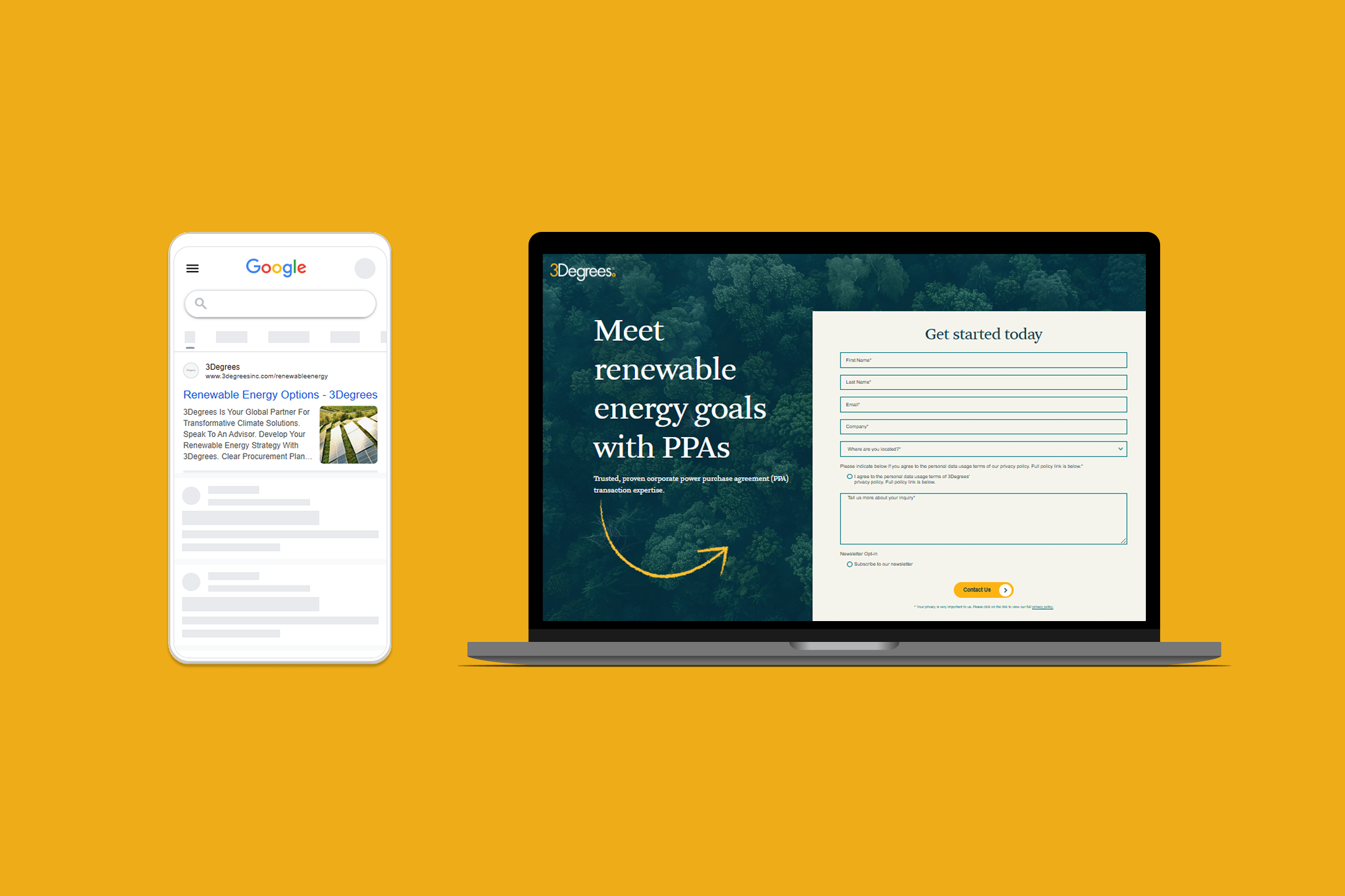
Skills: Google Ads
Challenge
When I stepped in to lead Google Ads at 3Degrees, a global climate solutions provider, the directive was to increase year-over-year marketing-qualified leads. There was also an emphasis on growing leads from European companies, where the business had expanded in recent years and was still gaining traction. At the same time, leadership was evaluating whether Google Ads should remain a core channel for supporting those goals, as its cost prompted questions about whether there were more efficient ways to drive demand. That made it important for me to pair improvements in performance and cost efficiency with any increase in spend.
An audit quickly revealed a major efficiency issue. Dozens of campaigns were running simultaneously, split by product or service and, in some cases, geography. While this structure offered theoretical control, it spread the available budget so thin that many campaigns operated with daily caps 10–20x lower than the company’s average cost per lead. At that level, consistent performance was unrealistic. The account reflected legacy decisions that may have made sense in another context, but were not a strong fit for the current operating reality.
Solution
Rather than fine-tuning an overextended structure, I focused on simplifying it. I worked with the team to get buy-in on a consolidation strategy, grounded in the idea that concentrating spend would unlock more opportunity than spreading it thin.
The dozens of legacy campaigns were retired and replaced with five new core campaigns, using ad groups to maintain coverage across product and service offerings. This reduced manual control over budget prioritization, but allowed real search demand to determine where spend flowed. With the budget now spread across fewer campaigns, we were able to compete more effectively in auctions and let performance guide allocation.
In parallel, I also optimized landing pages to reduce friction. Contact forms were made more prominent, with multiple touchpoints throughout the page to capture intent as it emerged.
Result
The streamlined structure delivered near-immediate gains, driving a 40% year-over-year increase in total Google Ads leads. Within that growth, leads from European companies tripled. These results came alongside higher lead quality, reflected in improved MQL-to-SQL conversion rates. Cost per lead also improved. By aligning budget, structure, and demand, paid search became a more efficient and reliable growth channel.